1. 다음 중 짝지어진 대화가 어색한 것은?
① A: What does “It’s raining cats and dogs” mean?
B: It means “It’s raining a lot.”
② A: Would you like some of my spaghetti?
B: No, thanks. Spaghetti is not my cup of tea.
③ A: I feel under the weather.
B: Today’s weather forecast is ‘rainy’.
④ A: Hello. What can I do for you?
B: Can I exchange this black umbrella for a different color?
⑤ A: What size would you like?
B: Large, please.
2. 다음 대화의 빈칸에 들어갈 알맞은 것은? ③
[3과]
G: This juice is on me, Suho.
B: Excuse me? Can you say that again?
G: I said, “This juice is on me.” It means “______________________________.”
B: Oh. Thanks a lot.
G: You’re welcome.
① I don’t like juice.
② This juice is sweet.
③ I’ll pay for the juice.
④ I’m allergic to juice.
⑤ I already had two glasses.
3. 다음 표현의 의미를 알맞게 쓴 것은?
I’ll keep my fingers crossed for you.
① Good luck.
② Good job.
③ I love what I do.
④ I didn’t lift a finger.
⑤ I’m not very good at work.
4. 다음 대화의 빈칸에 들어갈 말로 알맞은 것은?
W: Hello. May I help you?
B: Yes, please. I’d like to get _______________ for this watch.
W: OK. Was there anything wrong with it?
B: No, I just changed my mind. Can I get my money back?
W: OK. I’ll take care of it right away.
① a repair ② a receipt
③ an exchange ④ a refund
⑤ an after-sales service
5. 다음 대화의 흐름에 맞게 (A)~(D)의 순서를 바르게 배열한 것은?
Hello. Do you need some help?
(A) Yes. I’d like to return this smartphone case.
(B) Let’s see. Do you have the receipt with you?
(C) Here it is. I bought it three days ago.
(D) Oh, then it’s possible.
① (A) - (B) - (C) - (D)
② (A) - (D) - (B) - (C)
③ (A) - (D) - (C) - (B)
④ (B) - (A) - (D) - (C)
⑤ (C) - (B) - (A) - (D)
6. 다음 중 밑줄 친 단어의 쓰임이 어색한 것은?
① Lin is from China. She is Chinese.
② Hans is from Germany. He is German.
③ Mia is from Italy. She is Italian.
④ Kim is from Korea. He is Korean.
⑤ James is from France. He is Francer.
7. 다음 중 짝지어진 두 단어의 관계가 나머지와 다른 하나는?
① loose – tight ② true – correct
③ easy – difficult ④ smart – foolish
⑤ same – different
8. 다음 중 단어의 영영 풀이가 잘못 연결된 것은?
① century: a period of one hundred years
② soap: a substance that you use with water to wash yourself
③ allowance: money that your parents give you regularly
④ habit: something that you do often or regularly
⑤ weekly: once a month, or every month
★ 다음 글을 읽고 물음에 답하시오.
English has often borrowed words from other cultures or languages. Here are some examples with interesting storeies.
<shampoo>
The word shampoo comes from the Hindi word chāmpo, __________ means “to press.” In India, the word was used for a head massage. British traders in India experienced a bath with a head massage and introduced it to Britain in the 18th century.
The meaning of the word shampoo changed a few times after it first entered English around 1762. In the 19th century, shampoo got its present meaning of “washing the hair.” Shortly after that, the word began to be also used for a special soap for the hair.
9. 위 글의 빈칸에 들어갈 알맞은 말은?
① who ② whose ③ that
④ which ⑤ what
10. 위 글의 내용과 일치하지 않는 것은?
① 영어는 다른 문화나 언어에서 단어를 종종 빌려 왔다.
② shampoo라는 단어는 힌디어 단어인 chāmpo에서 왔다.
③ 인도의 무역상들이 머리 마사지를 곁들인 목욕을 18세기에 영국에 소개 했다.
④ shampoo라는 단어는 1762년쯤 영어에 처음 들어왔다.
⑤ 19세기에 shampoo는 ‘머리 감기’라는 현재의 의미를 갖게 되었다.
★ 다음 글을 읽고 물음에 답하시오.
<robot>
The word robot comes from the play R.U.R., which ⓐwrote in 1920 by a Czech writer Karel Čapek. In the play, robots are machines that ⓑlooks like humans. They ⓒdesigned to work for humans and are produced in a factory.
It is interesting that the idea of using the word robot didn’t come from Karel Čapek himself. He originally ⓓcalled the machines in his play labori from the Latin word for “work.” (A)__________, his brother suggested roboti, which means “slave workers” in Czech. Karel Čapek liked the idea and decided to use the word roboti. In 1938, the play ⓔmade into a science fiction show on television in Britain.
11. 위 글의 ⓐ~ⓔ 중 어법상 쓰임이 옳은 것은?
① ⓐ ② ⓑ ③ ⓒ ④ ⓓ ⑤ ⓔ
12. 위 글의 밑줄 친 (A)에 들어갈 알맞은 말은?
① Also ② However
③ So ④ For example
⑤ In addition
13. 위 글을 읽고 답할 수 없는 것은?
① What are robots in the play R.U.R.?
② Who wrote the play R.U.R.?
③ What does roboti mean in Czech?
④ What did Karel Čapek originally call the machines in his play?
⑤ Did the science fiction show on TV become popular with the public?
★ 다음 글을 읽고 물음에 답하시오.
The word hurricane comes from the Spanish word huracán, ⓐwhich ⓑoriginates from the name of a Mayan god. In the Mayan creation myth, Huracán is the weather god of wind, storm, and fire, and he is one of the three gods who created humans. However, the first humans angered ⓒthe gods, so Huracán caused a great flood.
The first Spanish contact with the Mayan civilization was in 1517. Spanish explorers who were passing through the Caribbean experienced a hurricane and picked up the word for ⓓit from the people in the area. In English, one of the early uses of hurricane was in a ⓔplay by Shakespeare in 1608.
14. 위 글의 ⓐ~ⓔ에 대한 설명으로 옳지 않은 것은?
① ⓐ which는 계속적 용법의 주격관계대명사로, 선행사인 huracán에 대해 부연 설명을 하고 있으며 ‘that’으로 바꿔 쓸 수 있다.
② ⓑ originates from은 ‘~에서 유래하다’라는 의미이다.
③ ⓒ the gods는 앞 문장에 나온 the three gods를 가리킨다.
④ ⓓ it은 앞에 나온 a hurricane을 가리킨다.
⑤ ⓔ play는 ‘희곡’이라는 뜻의 명사로 쓰였다.
15. 위 글을 읽고 답할 수 없는 것은?
① What Spanish word does hurricane come from?
② Who is Huracán in the Mayan creation myth?
③ Why were the first humans anger the gods?
④ When was the first Spanish contact with the Mayan civilization?
⑤ Where do you find one of the early uses of hurricane in English?
16. 다음 글의 흐름상 ⓐ~ⓔ 중 관련 없는 문장은?
Do you have any money worries? Let’s talk with Dr. Money.
Q. I’m Jason. ⓐI get a weekly allowance, but I never have enough. ⓑBy Thursday, all of my money is gone. I don’t know how to solve this problem.
A. Hi, I’m Dr. Money. Let’s look at your spending diary. You used up most of your money at the beginning of the week. Here’s my tip. ⓒDon’t carry around all of your weekly allowance. ⓓIt’s important to save money. ⓔDivide the money into days. Then carry only the money you need for each day.
① ⓐ ② ⓑ ③ ⓒ ④ ⓓ ⑤ ⓔ
17. 다음 도표의 내용과 일치하지 않는 것은?
<Graph 1>
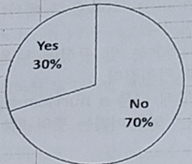
ARE YOU SMART WITH YOUR MONEY?
</graph 2>
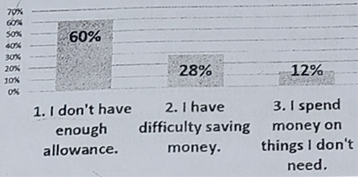
What is your biggest money worry?
Graph 1
Are you smart with your money?
ⓐ70% of the students answered “No.”
ⓑ30% of the students answered “Yes.”
Graph 2
What is your biggest money worry?
ⓒ60% think they don’t have enough allowance
ⓓ28% don’t think they have difficulty saving money.
ⓔ12% said they spent money on things they didn’t need.
① ⓐ ② ⓑ ③ ⓒ ④ ⓓ ⑤ ⓔ
★ 다음 글을 읽고 물음에 답하시오.
Q. Hello, Dr. Money. I’m Steve. (A) I have difficulty saving money. ⓐ__________, I’ve been saving to go to my favorite singer’s concert for the last two months. ⓑ__________, I still don’t have enough money. I don’t know what to do. (B)
A. Let’s see. In the last few weeks, you spent 80% of your allowance and only saved 20%. I think you’ve been spending too much. (C) To save money, you need to have a tighter budget. ⓒ__________, you can follow the 50%-40%-10% rule. (D) Save 50%, spend 40%, and donate the remaining 10% to charity. (E) Then you can save money faster to buy the ticket.
18. 위 글의 ⓐ~ⓒ에 들어갈 말이 바르게 짝지어진 것은?
ⓐ ⓑ ⓒ
① So For example However
② For example However For example
③ However So For example
④ For example So However
⑤ So However For examaple
19. 위 글의 (A)~(E) 중 주어진 문장이 들어갈 가장 적절한 위치는?
By following the rule, you can manage your money better.
① A ② B ③ C ④ D ⑤ E
★ 다음 글을 읽고 물음에 답하시오.
Q. I’m Minji. I like to buy things on sale. If something’s on sale, I buy it (A)__________ I don’t need it. Last week, I bought two T-shirts on sale, but I already have many.
A. Buying things on sale ⓐare good if you buy things you need. In your case, the problem is ⓑwhat you buy things you don’t even need. Here ⓒare some advice. Before you buy something, ask yourself, “Do I really need this?” Also, before you go shopping, make a shopping list. Don’t buy items that ⓓisn’t on the list ⓔeven if they’re on sale. Then (B)______________________________.
20. 위 글의 ⓐ~ⓔ 중 어법상 쓰임이 옳은 것은?
① ⓐ ② ⓑ ③ ⓒ ④ ⓓ ⑤ ⓔ
21. 위 글의 빈칸 (A)에 들어갈 말로 알맞은 것은?
① before ② although
③ after ④ while
⑤ because
22. 위 글의 흐름상 빈칸 (B)에 들어갈 말로 가장 적절한 것은?
① you won’t buy things on the spot
② you can buy things at a cheap price
③ you can donate the money to charity
④ you can buy all the things you want
⑤ you will get praise from your parents
23. 다음 중 어법상 바르지 않은 문장은?
① He has been watching TV all day.
② I heard that one of the machine was broken.
③ It is true that Mike will move to Busan.
④ How long have you been waiting for me?
⑤ I have not been eating anything since this morning.
24. 다음 중 어법상 맞는 문장의 개수는?
ⓐ We saw the latest Harry Potter film, who we really enjoyed.
ⓑ The Olympic Games, that take place every four years, were first held in 1896.
ⓒ It said that he was a soccer player when he was young.
ⓓ Her uncle, who she is very proud of, is a pilot.
ⓔ Linda and Jane has been reading books for three hours.
ⓕ I have been knowing him for 10 years.
① 1개 ② 2개 ③ 3개
④ 4개 ⑤ 5개
[정답]


댓글